

22 mai 2026
Norme mondiale BRC : Nouveautés de la version 9
La norme BRCGS Food Safety, dans sa version 9, définit les exigences auxquelles doit répondre une entreprise de fabrication de denrées alimentaires afin d’obtenir la certification conformément à la Norme mondiale de sécurité des aliments.
Cette certification garantit la sécurité, l’intégrité, la légalité et la qualité des produits alimentaires tout au long de la chaîne de production.
Parmi les exigences de la norme BRCGS Food Safety (version 9), certaines sont considérées comme « fondamentales ». Le nettoyage et l’hygiène (clause 4.11) en font partie et constituent un élément essentiel pour l’élaboration et la mise en œuvre d’un programme efficace de qualité et de sécurité des aliments.
Conséquences du non-respect des exigences
Le non-respect des exigences fondamentales de la norme BRCGS Food Safety, ainsi que la présence de non-conformités critiques, peuvent avoir des conséquences importantes. L’une des principales conséquences est le refus ou la perte de la certification, ce qui peut entraîner un désavantage concurrentiel ainsi qu’une perte de confiance de la part des différentes parties prenantes (fournisseurs, clients et consommateurs).
Par ailleurs, une mise en œuvre inefficace des procédures de nettoyage et d’hygiène peut entraîner des toxi-infections alimentaires, des contaminations croisées ou la présence involontaire d’allergènes dans des produits destinés à la consommation humaine. Ces situations peuvent porter atteinte à la santé des consommateurs, entraîner le retrait ou le rappel des produits du marché et engendrer, par conséquent, des pertes économiques ainsi qu’une dégradation de l’image et de la réputation de l’entreprise.
Exigences de la clause 4.11 et application pour une mise en oeuvre efficace
La mise en œuvre efficace des exigences fondamentales et, dans notre cas, de celles énoncées dans la clause 4.11 (Nettoyage et hygiène), dépend du niveau de conformité aux différents points de la norme ainsi que de leur application rigoureuse. De manière générale, la clause 4.11 est structurée en trois parties : les exigences générales relatives au nettoyage et à l’hygiène, les exigences liées à la mise en œuvre d’un système de nettoyage en place (CIP) efficace et les exigences relatives au programme de surveillance environnementale.
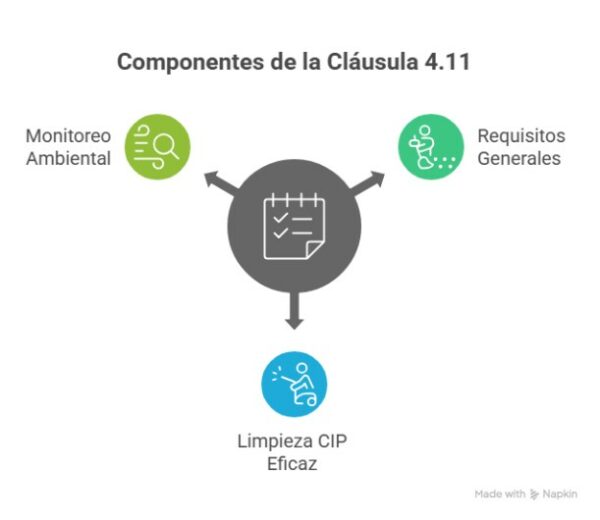
Vous trouverez ci-après un résumé détaillé du contenu de cette clause, destiné à faciliter la compréhension de chacune de ses exigences et à favoriser leur mise en œuvre efficace:
Exigences générales
4.11.1. Les équipements de production ainsi que les installations doivent être maintenus dans un état de propreté et d’hygiène satisfaisant.
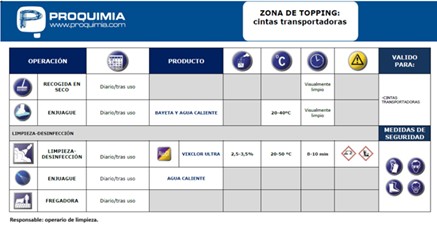
L’état général de l’usine ainsi que l’état spécifique des équipements seront vérifiés sur site lors de l’audit. Les résultats des opérations de nettoyage réalisées avant l’audit seront également examinés au moyen des enregistrements de nettoyage.4.11.2. L’entreprise doit mettre en œuvre et maintenir des procédures documentées de nettoyage et de désinfection couvrant les bâtiments, les installations et l’ensemble des équipements.
Les procédures de nettoyage applicables aux équipements de transformation alimentaire ou aux surfaces entrant en contact avec les aliments doivent inclure, au minimum :
- le personnel responsable des opérations de nettoyage, en veillant à ce qu’il ait reçu une formation appropriée ;
- l’équipement, l’installation, l’élément ou la zone à nettoyer ;
- la fréquence des opérations de nettoyage (quotidienne, hebdomadaire, mensuelle ou autre) ainsi que la méthode utilisée (manuelle, par immersion, par mousse ou autre), sur la base d’une évaluation des risques ;
- les éventuelles opérations de démontage nécessaires ;
- le nom des produits chimiques utilisés ainsi que leur concentration d’utilisation ;
- le matériel de nettoyage employé (éponges abrasives, brosses, raclettes, etc.), identifié au moyen d’un système de codification approprié.
Il est essentiel de garantir l’accès à l’ensemble des zones difficiles à atteindre afin d’assurer un nettoyage efficace et de prévenir tout risque de contamination.
4.11.3. L’entreprise doit disposer de la validation des procédés de nettoyage et de désinfection des équipements ou des surfaces en contact avec les aliments, ainsi que des critères d’acceptabilité et de non-acceptabilité du nettoyage, définis sur la base des risques potentiels liés au produit ou à la zone de transformation.
Les méthodes de vérification du niveau d’acceptabilité du nettoyage et de la désinfection doivent être mises en œuvre selon les modalités jugées appropriées (inspection visuelle, analyses microbiologiques de surfaces, etc.).
Les actions correctives à mettre en œuvre en cas d’écart doivent également être définies. À titre d’exemple, une action corrective peut consister à réaliser un nettoyage renforcé de la zone contaminée à l’aide de produits chimiques plus efficaces que ceux utilisés habituellement.
4.11.4. Les ressources nécessaires doivent être disponibles afin d’assurer un nettoyage efficace et planifié de l’intérieur comme de l’extérieur des équipements. Une attention particulière doit être portée aux opérations nécessitant le démontage de certaines parties des équipements, car elles peuvent requérir la collaboration d’autres services, notamment le service de maintenance.
4.11.5. L’entreprise doit disposer d’enregistrements des résultats des contrôles de nettoyage, quelle que soit la méthode utilisée, afin de garantir que la production peut reprendre sans risque de contamination et d’identifier les tendances liées à l’efficacité du nettoyage, en vue de mettre en œuvre les améliorations nécessaires.
Par exemple, certaines bactéries peuvent développer une résistance à certains désinfectants après une utilisation prolongée. La conservation de l’historique des résultats permet alors d’adapter la matière active utilisée afin d’améliorer les résultats microbiologiques.
Par ailleurs, la base de données utilisée pour l’évaluation statistique des résultats doit comprendre, au minimum, les informations relatives à la zone échantillonnée, à son niveau de criticité ainsi qu’aux résultats microbiologiques obtenus sur les différents points de prélèvement durant une période donnée.
4.11.6. Le matériel et les équipements de nettoyage doivent être conçus selon des principes hygiéniques, être adaptés à leur utilisation et être identifiés au moyen d’un code couleur afin d’éviter toute contamination croisée entre des zones présentant différents niveaux d’hygiène.
Ils doivent être maintenus en permanence dans un état de propreté satisfaisant et stockés dans un endroit où ils ne risquent pas d’être contaminés.
Exigences relatives au CIP
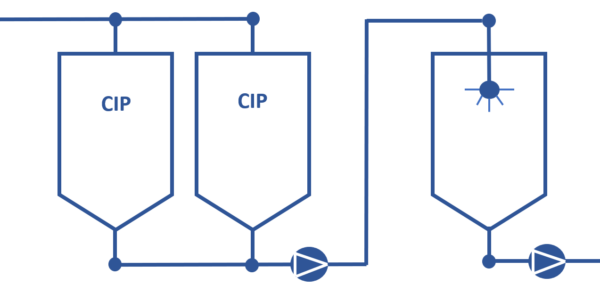
4.11.7.1. Il est essentiel de disposer d’une validation démontrant la conception et le bon fonctionnement des installations CIP, ainsi que d’un schéma actualisé de leur configuration. Il est nécessaire d’inclure le maximum d’informations pertinentes concernant les caractéristiques de l’installation : équipements à nettoyer, diamètres et longueurs des tuyauteries, débits et puissances des pompes, entre autres. Une attention particulière doit être portée à la récupération ou à la réutilisation des solutions de rinçage lors des opérations de nettoyage CIP. Dans ce cas, une évaluation des risques de contamination croisée doit être réalisée.
Les modifications du système CIP ne peuvent être effectuées que sous l’autorité d’une personne dûment formée, car toute modification des recettes ou des programmes de nettoyage peut avoir des conséquences graves, notamment la présence de résidus chimiques dans le produit fini en raison d’un rinçage insuffisant. Toute modification, après vérification et approbation, doit être enregistrée et conservée.
L’ensemble des éléments mentionnés précédemment doit être revalidé selon une fréquence fondée sur l’analyse des risques, ainsi qu’après toute modification ou tout ajout apporté à l’installation, afin de garantir l’efficacité du nettoyage.
4.11.7.2. L’élimination des dangers doit être garantie par la validation des limites critiques associées aux principaux paramètres du procédé CIP. Au minimum, les paramètres suivants doivent être validés :
- la durée de chaque étape ;
- la concentration des détergents et/ou des désinfectants ;
- le débit ;
- la pression ;
- la température.
Toutes les limites définies doivent être enregistrées à l’issue de la validation.
Cette validation doit être réalisée sur un nombre suffisant de cycles de nettoyage afin d’obtenir des données représentatives, en tenant compte des types de salissures et des caractéristiques de l’installation. Il est recommandé de réaliser au minimum trois cycles de nettoyage.
4.11.7.3. Les équipements et les composants du système CIP nécessitant une maintenance doivent être correctement entretenus par du personnel qualifié afin de garantir que les opérations de nettoyage sont réalisées conformément aux spécifications définies.
Dans le cadre du fonctionnement quotidien d’une usine, la vérification régulière des concentrations de détergent peut permettre de détecter d’éventuelles anomalies dans la préparation des solutions de nettoyage du système CIP, telles qu’un dysfonctionnement des conductivimètres de la ligne. Par ailleurs, le contrôle des solutions récupérées après rinçage peut fournir des indications utiles pour détecter d’éventuelles accumulations de résidus provenant des cuves de détergent.
4.11.7.4. Les installations CIP doivent faire l’objet d’une surveillance à une fréquence définie sur la base des risques. Cette surveillance peut notamment inclure :
- le contrôle des paramètres du procédé définis au point 4.11.7.2 ;
- la vérification des raccordements, des tuyauteries et de leur configuration ;
- la confirmation du bon fonctionnement du procédé et de la bonne exécution du cycle de nettoyage ;
- la vérification de l’obtention de résultats satisfaisants.
Les procédures doivent définir les actions à mettre en œuvre lorsque la surveillance indique que le procédé fonctionne en dehors des limites établies.
Il est recommandé de réaliser périodiquement des validations en collaboration avec le fournisseur des produits chimiques afin de garantir des conditions de fonctionnement optimales.
Il est également conseillé de réaliser des audits visant à optimiser la consommation d’eau et de produits chimiques, les exigences environnementales revêtant une importance croissante.
Surveillance environnemental : contrôle des surfaces
L’exigence prévoit la mise en œuvre de programmes de surveillance environnementale fondés sur l’analyse des risques afin de détecter les agents pathogènes ou les micro-organismes d’altération.
Au minimum, ces programmes doivent couvrir l’ensemble des zones de production dans lesquelles sont manipulés des produits ouverts et/ou prêts à être consommés.
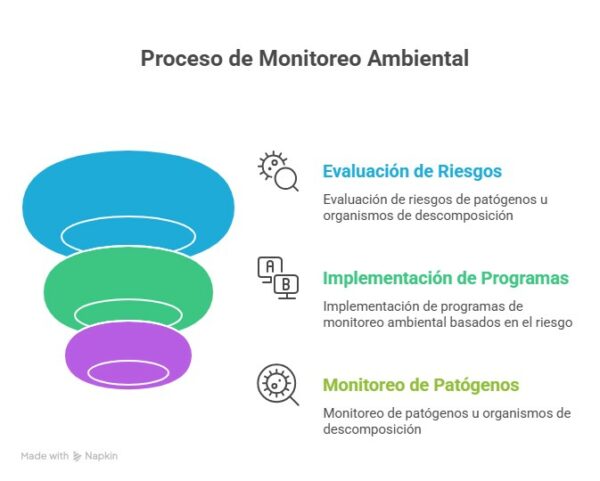
4.11.8.1. Le programme de surveillance environnementale doit être fondé sur une analyse des risques et inclure, au minimum :
- les procédures d’échantillonnage et l’identification des points de prélèvement ;
- la fréquence des analyses ainsi que les micro-organismes ciblés ;
- les méthodes d’analyse ;
- l’enregistrement et l’évaluation des résultats.
Le programme ainsi que les procédures associées doivent être documentés.
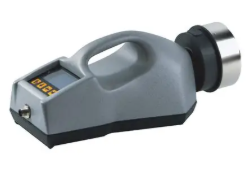
L’échantillonnage de l’air ambiant doit également être pris en compte dans ce programme. Des équipements automatiques de prélèvement peuvent être utilisés à cet effet. Une attention particulière doit être portée aux salles propres, où la maîtrise des flux d’air est essentielle pour éviter les contaminations croisées.
Un niveau élevé de contamination environnementale peut être lié à un nettoyage insuffisant des surfaces. Par ailleurs, lorsque les équipements de nettoyage génèrent des aérosols ou des particules, la contamination peut se propager dans l’environnement.
Afin de compléter le nettoyage et la désinfection des zones, des équipements et des installations, des produits homologués pour la désinfection aérienne ainsi que des équipements spécifiques peuvent être utilisés.
4.11.8.2. Les limites de contrôle ainsi que les actions correctives à mettre en œuvre doivent être définies en cas d’écarts ou de résultats présentant une tendance à la hausse.
4.11.8.3. Le programme doit être revu par l’entreprise au moins une fois par an ou dans les situations suivantes :
- modifications des conditions de production, du flux de fabrication ou des équipements susceptibles d’affecter le programme de surveillance environnementale ;
- nouvelles avancées scientifiques ;
- écarts constatés lors des audits et qui n’avaient pas été identifiés auparavant par le programme ;
- produits présentant des résultats positifs ou des résultats négatifs récurrents.
Non-conformités BRC les plus fréquentes
Selon BRCGS Food Safety, le Top 5 des non-conformités les plus fréquemment relevées en matière de sécurité alimentaire pour la période 2024-2025 est le suivant :
- Clause 4.11.1
Les installations et les équipements ne sont pas maintenus dans un état de propreté et d’hygiène satisfaisant (4 715 non-conformités). - Clause 4.6.2
La conception et la construction des équipements ne prennent pas suffisamment en compte les risques de contamination des produits (3 322 non-conformités). - Clause 4.9.1.1
Absence de procédures adéquates pour la gestion de l’utilisation, du stockage et de la manipulation des produits chimiques afin d’éviter toute contamination chimique (3 284 non-conformités). - Clause 4.4.8
Les portes intérieures et extérieures ne sont pas maintenues en bon état (3 007 non-conformités). - Clause 4.4.1
Les murs ne sont pas correctement finis ou entretenus afin d’éviter l’accumulation de salissures, la condensation ou le développement de moisissures, et de faciliter le nettoyage (2 933 non-conformités).
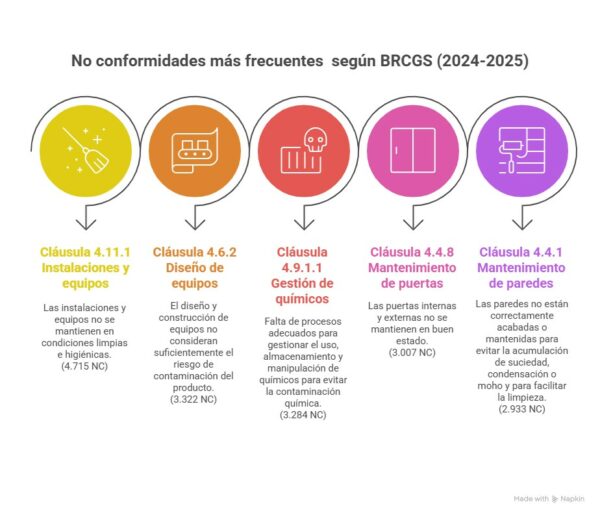
Ainsi, la clause 4.11.1, relative au maintien des installations et des équipements dans un état de propreté et d’hygiène satisfaisant, constitue la principale source de non-conformités, avec un total de 4 715 cas recensés.
Cette donnée met en évidence les difficultés rencontrées par le secteur pour garantir des niveaux adéquats d’hygiène opérationnelle et souligne l’importance de revoir, d’actualiser et de renforcer les procédures de nettoyage et de désinfection.
Conclusion
Dans ce contexte, l’expérience acquise par Proquimia depuis plus de 50 ans dans le domaine de l’hygiène alimentaire démontre que le respect efficace des exigences réglementaires ne repose pas uniquement sur la connaissance théorique des clauses, mais également sur leur application pratique et continue sur le terrain.
La combinaison de solutions chimiques spécifiques (détergents et désinfectants) avec la conception, la mise en œuvre et la vérification de procédures de nettoyage et de désinfection adaptées à chaque installation constitue un facteur clé pour minimiser les risques et garantir des résultats durables. Cette approche permet non seulement de répondre aux exigences de la norme BRCGS Food Safety, mais également d’optimiser les ressources, de réduire les non-conformités et de tendre vers des niveaux élevés d’excellence opérationnelle.
En définitive, l’adoption d’une approche globale du nettoyage et de la désinfection, intégrant les produits, les procédés et les contrôles associés, constitue le moyen le plus efficace de garantir la sécurité des aliments, de préserver l’image de marque et de répondre aux exigences croissantes du marché.
Bibliographie
Brcgs. (2022). BRC Global Standard for Food Safety: Issue 9. British Retail Consortium.
https://www.brcgs.com
Brcgs. (2025). BRCGS Annual Report 2024-25. Https://www.brcgs.com/media/zqxnctso/brcgsannualreport2024-25-screen.pdf


Voulez-vous plus d'informations?
Nous vous aidons
Conformément au règlement 2016/679 (GDPR), nous vous fournissons les informations de base sur la protection des données personnelles:
– Responsable du traitement: PROQUIMIA, S.A.
– Objectif du traitement: Gérer l’envoi d’informations, répondre aux questions ou collecter des données en vue d’éventuelles relations commerciales.
– Légitimation: Consentement de la personne concernée.
– Destinataires: Les données personnelles ne sont pas communiquées à des tiers, sauf en cas d’obligation légale.
– Droits: Accès, rectification, suppression, opposition, limitation, portabilité et introduction de réclamations.
– Informations complémentaires: Pour obtenir de plus amples informations quant à notre politique de protection des données, veuillez consulter notre site web: Politique de confidentialité